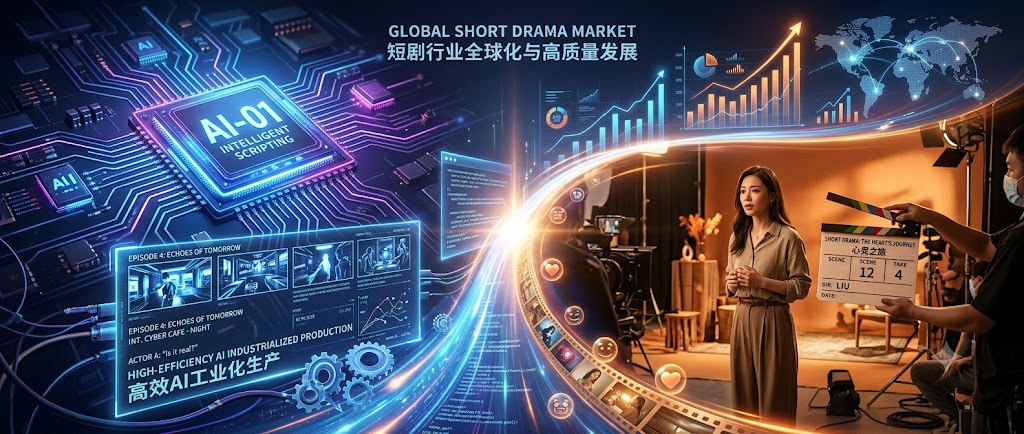
In 2026, China's micro-drama industry is experiencing unprecedented industrial transformation. Driven by the deep application of AI technology and the progressive refinement of regulatory policies, the short-form drama track has officially bid farewell to its early extensive development model, entering a new era where "AI industrialization" and "premium live-action production" progress in parallel.
AI Reshapes the Production Pipeline, Achieving Exponential Leaps in Capacity and EfficiencyThe AI boom is fundamentally restructuring the logic of micro-drama production. Data shows that in the first quarter of 2026, approximately 128,000 micro-dramas were released industry-wide, with AI-generated content accounting for over 95%. Leveraging proprietary AI creation engines, leading companies have compressed traditional live-action production timelines—which used to take weeks—into just 72 hours. Furthermore, the cost per minute of production has dropped by over 75% compared to traditional 3D animation. From script breakdown and storyboard generation to dynamic video rendering, AI has achieved a closed-loop workflow, propelling micro-drama production from a "manual craft system" to an "automated content industrial system."
However, this explosive growth in capacity brings the hidden risk of "content inflation." Over 90% of AI-generated short dramas have become casualties due to severe homogenization, prompting the industry to shift from "volume stacking" to "meticulous cultivation." An industry consensus is gradually forming: AI is an amplifier of efficiency, not a disruptor of storytelling. The logic behind future hits still relies on "compelling stories + emotional value." AI will increasingly handle the rendering of high-cost scenes like fantasy and sci-fi, while human creators will focus on emotional cores and narrative aesthetics.
Platforms Invest Heavily in Live-Action Short Dramas as Policies Guide Premium DevelopmentWhile AI-generated micro-dramas are surging, live-action short dramas have not been marginalized; instead, they are entering a window for high-quality development. Douyin Group announced an investment of over 1.5 billion RMB in guaranteed support budgets for 2026, while Hongguo (Red Fruit) Short Drama allocated a special fund of 500 million RMB to incentivize content innovation and the exploration of realistic themes in live-action productions. Platforms are guiding healthy competition by refining revenue-sharing mechanisms and optimizing traffic recommendation algorithms.
Regulatory authorities are also stepping up their efforts. The National Radio and Television Administration (NRTA) implemented new tiered management regulations for AI micro-dramas effective July 1, alongside the launch of the "Premium Micro-Drama Creation and Distribution Initiative." This aims to establish a synergistic coordination mechanism across the national administration, provincial bureaus, and platforms, cultivating a healthy ecosystem for continuous premium content iteration. With dual backing from policies and platforms, micro-drama creation is shifting from pursuing short-term traffic to pursuing long-term audience retention and social value.
Promotional and Actor Ecosystems Upgrade as Short Drama IPs Achieve Cross-Industry BreakoutsThe maturation of the micro-drama industry is reflected not only in content but also in the comprehensive upgrade of promotional and commercial ecosystems. Traditional trailer promotions have evolved into "content products," with diverse formats such as celebrity-directed spin-offs, AI VFX blockbusters, and interactive livestreams becoming powerful traffic drivers. Meanwhile, micro-drama actors are shedding their "niche" labels, building personal brands through high-quality promotional photos and "character aftercare," even gaining favor from mainstream fashion magazines and achieving "equal dialogue" with long-form drama actors.
Additionally, micro-dramas are serving as traffic engines to deeply empower the physical economy. Cross-industry integration models like "Short Drama + Cultural Tourism" and "Short Drama + E-commerce" have yielded significant results, driving offline tourist growth and substantially boosting viewer-to-buyer conversion rates. With two micro-drama IPs officially greenlit for feature film adaptations, the "cinematic transition" of short dramas has entered the implementation phase.
Looking back from the vantage point of 2026, the micro-drama industry is no longer just a traffic-driven business; it has grown into a vital "light cavalry" in China's online audio-visual sector. Driven by the dual engines of technological empowerment and premium-oriented guidance, micro-dramas are reshaping the global streaming content ecosystem with a more professional posture.